
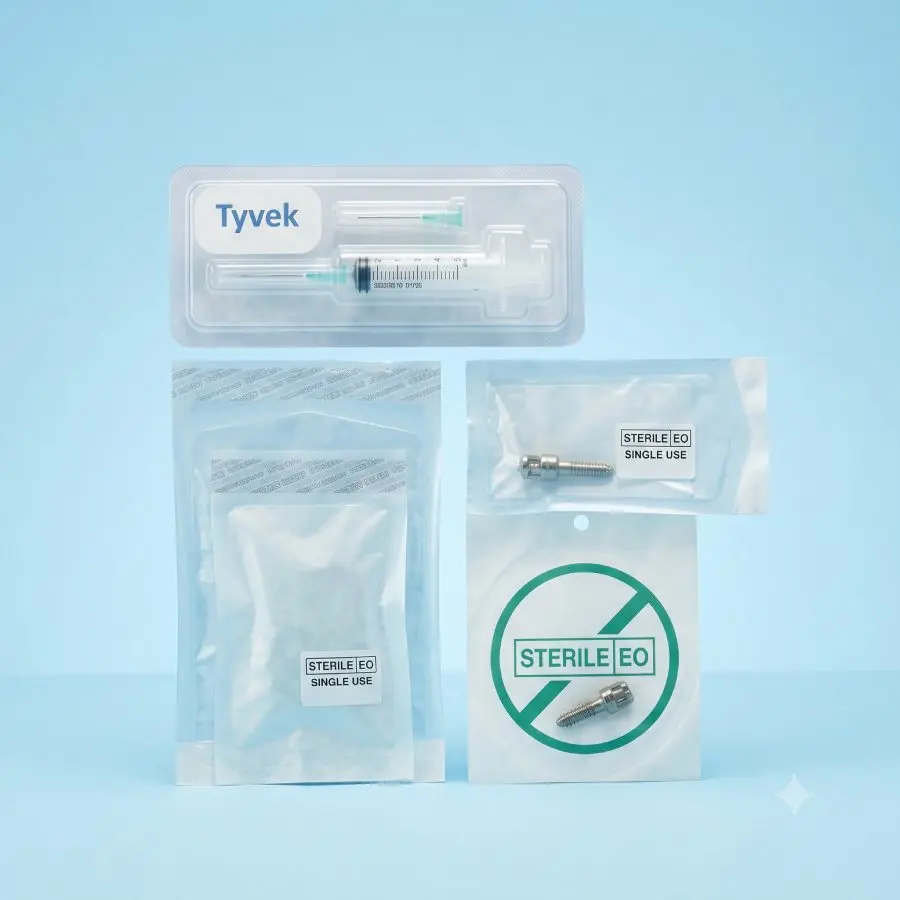
Packaging testing for Medical Devices
As an accredited testing laboratory, INNOPROOF provides cutting-edge mechanical validation for medical device packaging to ensure strict regulatory compliance and absolute product safety. Backed by extensive biomechanical expertise, we empower manufacturers worldwide to navigate the market launch of their innovations swiftly and confidently.
Because maintaining a sterile barrier is paramount for single-use devices and implants, even the slightest defect requires rigorous quality assurance. Our specialized testing services guarantee that your packaging systems withstand all logistical stresses, preserving sterile integrity from production to the point of care.
Customized Medical Packaging Testing Solutions
Next standard test methods, we also build special test setups when a product needs something more specific. Our team works directly with manufacturers to figure out what could go wrong in real life and then designs tests that can realistically check for those risks. This helps make sure the packaging is safe, reliable, and suitable for medical use.
We combine practical testing equipment with scientific and regulatory know-how to produce clear and trustworthy results. These results help companies improve their products, manage risks better, and get approval for different international markets more smoothly.
Importance of Standards in Medical Packaging Testing
By using standardized methods such as ISO 11607-1 and ISO 11607-2, manufacturers can demonstrate that their packaging meets regulatory expectations. At the same time, test methods like ASTM F88/F88M, ASTM F1929, and ASTM F2096 provide consistent and repeatable ways to evaluate seal integrity and package tightness.
For manufacturers, these standards help to:

Understanding the request & defining requirements
At the very beginning, we focus on understanding the medical packaging, its function, and the customer’s expectations. We clarify how the packaging must perform in real use, especially regarding sterility protection and transport safety. Based on this, we select the relevant international standards such as ISO 11607-1 to define a solid testing basis.
Creating the test concept & quotation
Next, we develop a customized test concept that fits the specific packaging system. This includes selecting suitable test methods (e.g. seal, leak, or mechanical tests), defining sample quantities, and estimating the project timeline. The customer receives a clear and structured quotation that explains all planned steps in simple terms.
Receiving samples & performing the tests
After approval, the packaging samples are sent to our laboratory, usually as finished products or prototypes. We then carry out the tests according to the agreed standards and procedures. This often includes mechanical stress tests such as compression testing according to ASTM D642 as well as seal integrity and leak detection tests. The goal is to reproduce realistic conditions such as transport, storage, and handling.
Evaluation & reporting of results
In the final step, all test data is carefully analyzed and documented in a clear and structured report. The report is prepared according to accredited standards and can be used for regulatory submissions and product optimization. It provides manufacturers with reliable results to improve packaging design and ensure compliance and safety.
Advanced testing technology
Our laboratory uses modern and high-precision testing systems, including equipment like the Instron ElectroPuls E3000. This allows us to perform dynamic and highly accurate mechanical tests on medical packaging. In this way, we can realistically simulate stresses that occur during transport, storage, and handling.
Direct communication & flexible collaboration
As an owner-managed company, we work with short decision paths and very direct communication. Clients always have clear contact persons and can quickly clarify questions or project details. This makes the whole testing process faster, more personal, and easier to manage.
Clear and useful test reports
We prepare test reports that are structured, easy to understand, and technically reliable. The results are presented in a clear format with tables, figures, and explanations. This helps customers use the data directly for product improvement, quality control, and regulatory submissions.