
ISO 7206-10 – Static burst test
The static burst test evaluates the strength of the ball head in connection with the stem taper. After assembling the head onto the stem taper with a defined force, a static axial load is applied to the ball head at a specified rate. One of the failure criteria is fracture of the head. For a successful test, five samples must withstand the defined maximum load without failure.
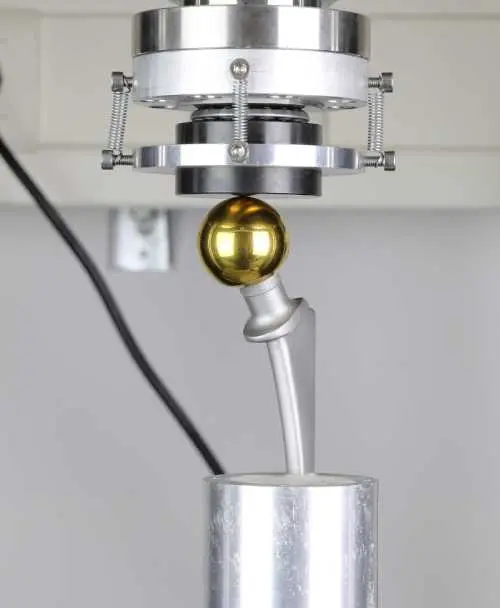
 The tests according to ISO 7206-4 and ISO 7206-6 focus on the stem and neck regions of the femoral component of hip replacements. Under specified cyclic loads and numbers of cycles, the fatigue strength of the hip stem is evaluated. The fixation method and applied loads vary depending on the design and length of the stem, which is classified as short stem, standard stem, or revision stem.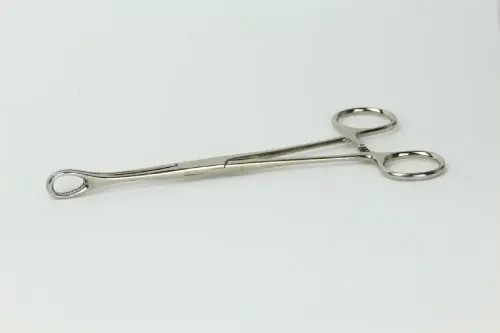
 ASTM F1089 describes physicochemical investigations of surgical instruments with a focus on corrosion.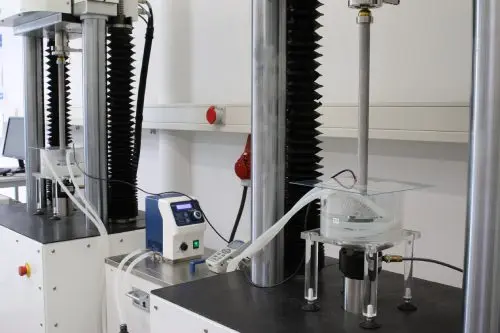
 We offer various test methods for the mechanical characterization of spinal fusion implants in accordance with ASTM F2077. Together with you, we select the appropriate test procedures for your individual fusion implants from the following options: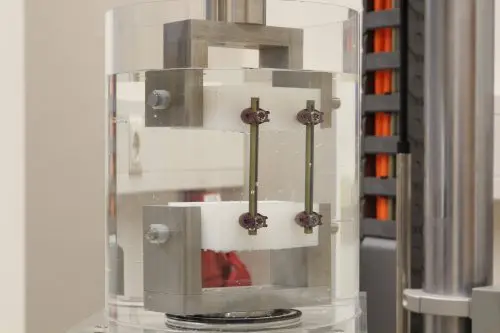
 We offer various test methods for the mechanical characterization of spinal implants in a vertebrectomy model in accordance with ASTM F1717. The vertebrectomy model simulates the bridging of a vertebral body without anterior support. The spinal implants are rigidly connected to two UHMWPE blocks with well-defined material properties, while a defined gap between the blocks simulates the absence of a vertebral body. The shape and properties of the test blocks are adapted to different regions of the spine (e.g., lumbar or cervical). Together with you, we select the appropriate test procedures for your individual spinal implants from the following options: