
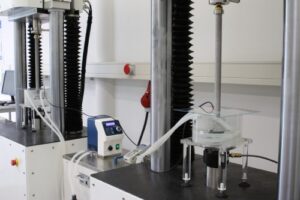
 We offer various test methods for the mechanical characterization of spinal fusion implants in accordance with ASTM F2077. Together with you, we select the appropriate test procedures for your individual fusion implants from the following options:
Static test methods
- Compression test:
The fusion implant is placed between two steel blocks and clamped in the test fixture. The surfaces of the blocks are adapted to the implant geometry. The construct is loaded with a constant displacement (max. 25 mm/min), and the force–displacement curve is recorded and evaluated with respect to mechanical properties (including stiffness and strength) under compression. - Shear test:
This test is performed in the same manner as the compression test, except that the lower block has a base inclined by 27° or 45°. As a result, both compressive and shear loads act on the implant. - Axial torsion:
As in the compression and shear tests, the fusion implant is clamped between two blocks. Depending on the intended implantation region of the spine, an axial preload of 100 N (cervical), 300 N (thoracic), or 500 N (lumbar) is applied. While maintaining constant axial load, a rotation is applied at a constant rate (60°/min), and a torque–rotation angle curve is recorded. This curve is evaluated with respect to mechanical properties (including stiffness and strength) under torsion.
Dynamic test methods
Following the static investigations, tests are performed dynamically using new specimens over 5 million cycles, with test blocks made of polyacetal. A constant ratio between maximum and minimum load of R = 10 must be maintained for dynamic compression and shear tests, and R = 1 for dynamic torsion tests. The maximum load should correspond to 25%, 50%, or 75% of the respective maximum load. Ultimately, the difference between two load levels at which the implant either fails dynamically or survives should be less than 10%. The test ends when 5 million load cycles are reached or when mechanical failure of the implants occurs. Tests are conducted under laboratory conditions (air and room temperature), but can also be repeated in Ringer’s solution at 37 °C if required to simulate physiological environmental conditions and possible corrosive effects.