
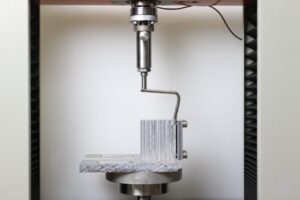
 We offer characterization of angled plates in accordance with ASTM F384. Specifically, we can perform static and dynamic bending tests:
- Static bending test
The angled plate is fixed to a rigidly clamped test block via the side plate, while the angled portion of the implant remains free. A constant displacement acting parallel to the side plate is applied to the angled portion of the implant (rate: 10 mm/min). Bending stiffness and bending strength are determined from the force–displacement curve. - Dynamic bending test
The angled plate is aligned in the same manner as in the static bending test and loaded over a defined number of cycles. The applied load should correspond to 75, 50, or 25% of the bending strength and be applied at a frequency of 1–10 Hz. Subsequently, an M–N diagram (maximum bending moment versus number of cycles) is generated and the fatigue strength is determined.
In addition to the mechanical characterization of angled plates, we are also pleased to advise you on correct labeling, packaging, and the content of the manufacturer information to be provided with the product.