
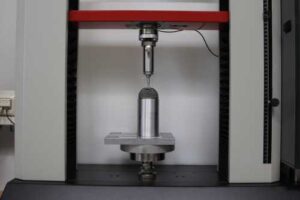
 This test evaluates the fixation of inserts in the acetabular shell to compare the effectiveness of different insert fixation mechanisms. It includes three different tests. The shell is fixed in all tests using a suitable fixture to prevent movement of the shell while allowing the insert to be released. Before each test, the insert is fixed in the shell with a force of 2000 N (ASTM F2345).
Axial push-out test
A displacement is applied to the insert along the polar axis through a hole in the pole of the acetabular shell until the insert detaches from the shell. The resulting force is measured.
Offset pull-out test or lever-out test
For this test, a slot or hole is first created inside the insert at approximately 80% of its depth. Then, an axial displacement parallel to the polar axis is applied to the insert via a rod (offset pull-out test). Alternatively, the insert can be levered out using a lever arm that engages the slot or hole (lever-out test).
Torsion test
For this test, grooves parallel to the polar axis are introduced into the insert, into which springs on a prepared ball head engage. Alternatively, a ball head can be glued into the insert. Then, torsion is applied around the polar axis via the ball head until the insert is released.