



Video of the ASTM F2096 Bubble Emission Test
Methods for the mechanical testing of medical packaging
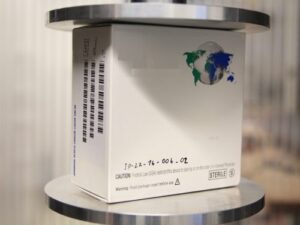 Packaging is tested under compression according to ASTM D642 in order to simulate transportation or storage conditions. The packaging sample is placed between two horizontal plates and subjected to static loading. The test is terminated when a specified deformation is reached or when a drop in reaction force occurs. The maximum applied test force and the corresponding deformation of the packaging are recorded.
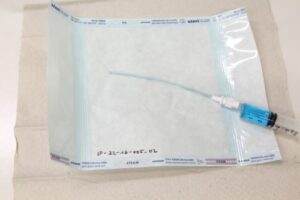 To evaluate the seal seam, dye is applied to one side of the seal. It is then visually examined whether the dye penetrates through the seal. Each side of the sample seal is observed for 5 seconds. The package must not contain liquids or condensation, as this could distort the test results. The dye used must provide strong contrast with the opaque packaging material. One of three methods is selected for seal testing.
Method A: Injection method The dye solution is injected into the package. The seal is observed to detect possible seal defects indicated by dye leaking from the inside to the outside.
Method B: Edge immersion method An outer edge of the seal is immersed in the dye solution. If dye penetrates from the outside to the inside, leakage points are present in the seal.
Method C: Pipette method
For this method, one outer edge of the package must remain unsealed. Using a pipette, drops of dye solution are applied to the inner side of the intact seal seam. The seal is then inspected for dye penetration.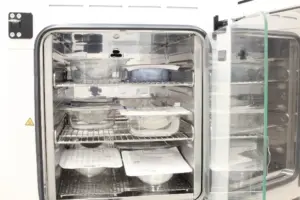 The ASTM F1980 standard (“Standard Guide for Accelerated Aging of Sterile Barrier Systems and Medical Devices”) provides guidelines for conducting accelerated aging tests on sterile packaging and medical devices. Its objective is to rapidly demonstrate expiration dates (shelf life) and the long-term integrity of sterile barrier systems (e.g., pouches, blister packs) without having to wait for years of real-time aging.
The packaged products are stored at elevated temperatures (commonly between 50 °C and 60 °C) and controlled humidity levels to thermally accelerate physical degradation processes. The mathematical basis of accelerated aging is the Arrhenius equation. This is grounded in the model that a 10 °C temperature increase approximately doubles the rate of aging reactions. As a result, 12 months of real-time aging can often be simulated in just a few weeks within an environmental chamber.
Following the calculated test duration, the packaging is tested for parameters such as seal strength, integrity (sterile barrier protection), and material embrittlement, while the medical device itself is evaluated for functionality.
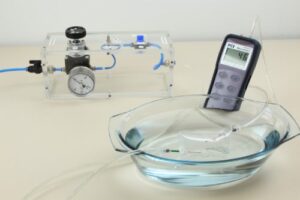 In the bubble emission test according to ASTM F2096, the integrity of packaging or sterile barrier systems is evaluated by applying internal pressure. For this purpose, the packaging film is punctured on one side using a needle, internal air pressure is applied, and the package is submerged in water. In our setup, a second needle and a digital manometer are used to directly measure the internal pressure.
To validate the procedure and to set the required internal pressure, a hole is intentionally introduced into the packaging using a 250 µm needle. The internal pressure is then adjusted until a continuous stream of air bubbles is produced.
We are pleased to perform leak testing of your packaging using the bubble emission test.
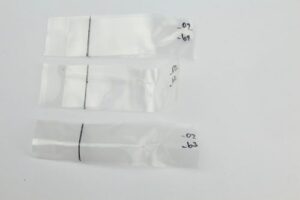 The seal strength of the packaging seam is tested in a tensile test. The packaging is cut into samples of defined size. Both ends of the seal are clamped, with one of three clamping configurations selected depending on the type of seal. The specimen is statically loaded at 200 to 300 mm/min until seal failure occurs. Only results obtained using the same clamping configuration may be compared.