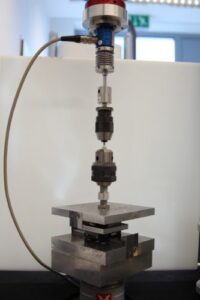
 The torsion test according to ISO/TS 13498 evaluates the torsional strength and maximum torque of implants or articulated connecting components of dental endosseous implant systems. This test is especially suitable for evaluating novel joint types, connectors, and new materials. The test is conducted at room temperature in air and should, as far as possible, simulate the clinical use of the implant. That is, specimens representative of the finished product are tested and sterilized as required according to the manufacturer’s instructions.
The maximum torque is determined on at least six identical specimens by clamping the sample into the testing machine and applying torque at a rate of one to ten degrees per minute. The torsional strength is determined at a rotation angle of 2°. During the test, a curve is recorded showing torque as a function of rotation angle, from which the maximum torque and torsional strength can be graphically determined. Broken or deformed parts of the implant are subsequently examined under a low-magnification microscope and documented in the test report.