
ISO/TR 18130 – Torsion testing between implant and abutment*
Using this method, we determine the extent of screw loosening at the connection between the implant body and abutment by applying cyclic torsional loading. The loosening torque of the abutment screw is measured both before and after the cyclic loading.
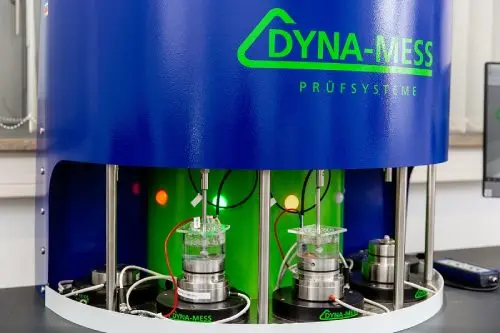
 DIN EN ISO 14801 describes a test method for fatigue (failure) of single-piece endosseous dental implants of various sizes and designs. The test should, as far as possible, simulate the clinical use of the implant, meaning that specimens representative of the finished product are tested and sterilized as required according to the manufacturer’s instructions. For testing, the specimen is rigidly clamped in the testing machine depending on the design (angled or non-angled abutments) and subjected to a uniaxial load for a defined number of cycles. To create a worst-case scenario, the implant is tilted by 30° during testing.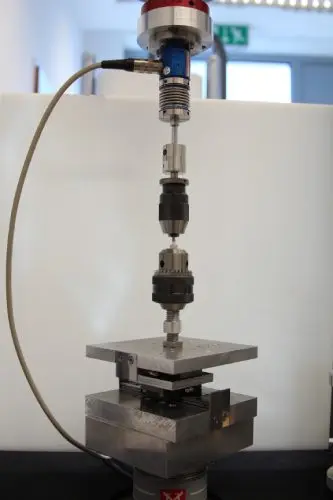
 The torsion test according to ISO/TS 13498 evaluates the torsional strength and maximum torque of implants or articulated connecting components of dental endosseous implant systems. This test is especially suitable for evaluating novel joint types, connectors, and new materials. The test is conducted at room temperature in air and should, as far as possible, simulate the clinical use of the implant. That is, specimens representative of the finished product are tested and sterilized as required according to the manufacturer’s instructions.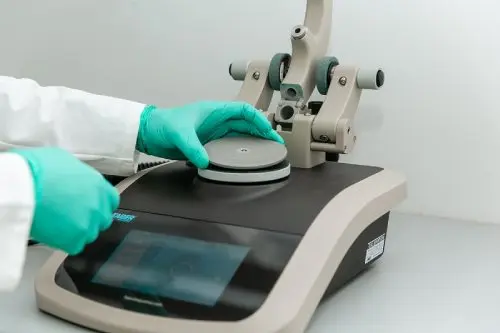
 We offer measurement of the abrasion resistance of metallic thermal spray coatings using a Taber Abraser in accordance with ASTM F1978-18. The coating under investigation is subjected to controlled pressure and abrasion conditions on rotating discs. The specimen, mounted on a rotating platform, turns about a vertical axis against the sliding rotation of two abrasive wheels. One wheel abrades the specimen outward toward the periphery, while the other abrades inward toward the center.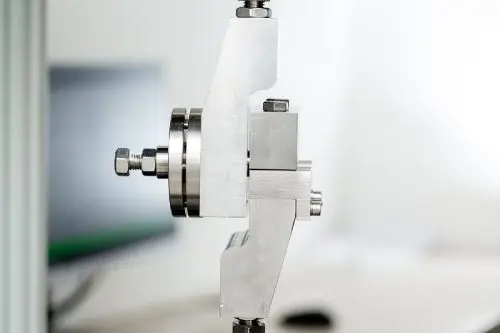
 For testing the shear strength of coatings, ISO 13179-1:2014 specifies dynamic tests that reference the corresponding method in ASTM F1160-14. The coating is applied to the end faces of two cylinders, which are bonded together prior to testing.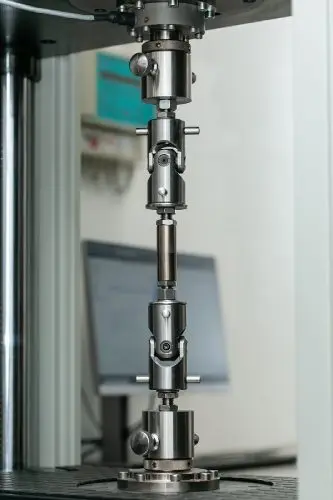
 ASTM F1147 specifies a static test setup for determining the tensile or adhesive strength of coatings. The coating is applied to the end face of a cylinder, which is bonded to a second cylinder according to a defined protocol prior to testing.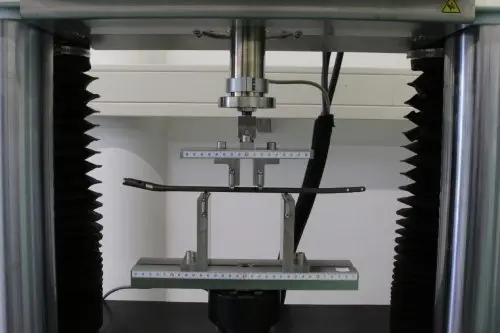
 We offer characterization of the design and mechanical performance of intramedullary nails in accordance with ASTM F1264.