
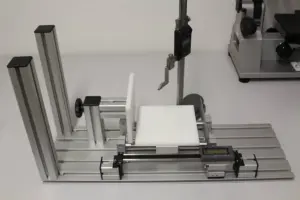
 For the morphological analysis, a test setup based on Jewell et al. 2018 was constructed. The setup consists of a sliding table that holds the breast implant sample. The sliding table is moved so that the specimen touches the stationary plate stop. The movable plate stop is connected to a horizontal caliper to measure the width of the implant. A digital height gauge is mounted next to the setup to measure projection and pole depth. The setup also allows assisted vertical alignment of the specimen.
Measured parameters include width, height, lower pole depth, and upper pole depth for anatomically shaped implants, and height, overhang, and upper pole depth for round implants. Each parameter is measured three times per device, with the implant removed and repositioned between measurements. The maximum projection for anatomically shaped implants is defined as the depth of the lower pole in a horizontal position, and the maximum projection for round implants is defined as the apex in the center of the device. The upper pole depth is the thickness of the upper pole, defined as 17% of the average horizontal height measured from the top of an anatomically shaped implant, or 25% of the average horizontal height measured from the top of a round implant.
Reference: Jewell ML, Bengtson BP, Smither K, Nuti G, Perry T. Physical Properties of Silicone Gel Breast Implants. Aesthet Surg J. 2019 Feb 15;39(3):264-275