
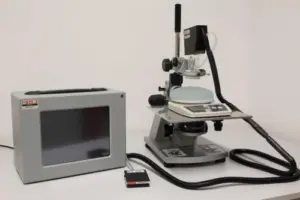
 The testing of gel material properties is conducted using our proprietary BTC-2000 device. The suction unit, which holds the laser unit, is mounted on a microscope stand with a micrometer drive. A scale is positioned on the microscope stand. The basic principle of gel elasticity testing involves applying a vacuum to a portion of the implant gel inside the cylindrical chamber of the suction unit and measuring the gel deformation with a laser. A 1 cm circular area of the implant shell is removed from the apex of the implant, and the gel is dusted with laser toner to enhance laser tracking of the surface.
The implant sample is placed on the scale, which is then tared. The cylindrical BTC test chamber is lowered onto the gel surface using the micrometer drive until a force of 5 g is registered on the scale. A vacuum is applied in the suction unit at a rate of 1 millimeter of mercury (mm Hg) per second until reaching 15 mm Hg. Deformation (mm) and pressure (mm Hg) values are recorded.
The resulting value, called “elastic deformation,” is defined as the deformation measured at maximum vacuum, representing the elastic response to the applied pressure. Higher values indicate “softness,” while lower deformations indicate “firmness.”
Reference: Kinney BM, Jeffers LLC, Ratliff GE, Carlisle DA. Silicone gel breast implants: science and testing. Plast Reconstr Surg. 2014 Jul;134(1 Suppl):47S-56S.