

Which mechanical tests on sports shoes does our laboratory offer?

In the sole fatigue test, the running behavior of a jogger performing hundreds of thousands of steps is simulated. The sole is repeatedly loaded and unloaded to realistically reproduce long-term use. Afterwards, the ability of the sole to recover and return to its original shape is evaluated. In addition, changes in cushioning, stiffness, and other mechanical properties caused by long-term cyclic loading are analyzed.
In this test, various sole materials such as EVA, TPU, or PEBA are subjected to defined impact loads. The objective is to objectively measure the cushioning behavior and energy absorption of the individual foam materials. After the loading tests, the materials are compared with respect to their mechanical properties. This makes it possible to determine which foam provides the best performance under identical conditions.
Impact and drop tests simulate hard impact loads such as those occurring during running or jumping. In particular, the heel area is subjected to defined impact forces. Measurements determine how effectively the shoe absorbs and distributes impact energy. In addition, the tests evaluate whether material damage or permanent deformations occur.
In bending and torsion tests, the shoe is repeatedly bent and twisted to replicate natural foot movements. These tests show how flexible or stiff the shoe is in both longitudinal and transverse directions. At the same time, it is evaluated whether materials or bonded joints begin to separate over time. The results provide important information about the stability and wearing comfort of the shoe.
Shear testing evaluates how well materials and material joints withstand lateral forces. Controlled shear forces are applied to the sole or to bonded interfaces between different layers. The objective is to assess adhesion strength and structural stability. This makes it possible to determine whether materials shift or separate under lateral loading.

Which types of sports shoes are tested?
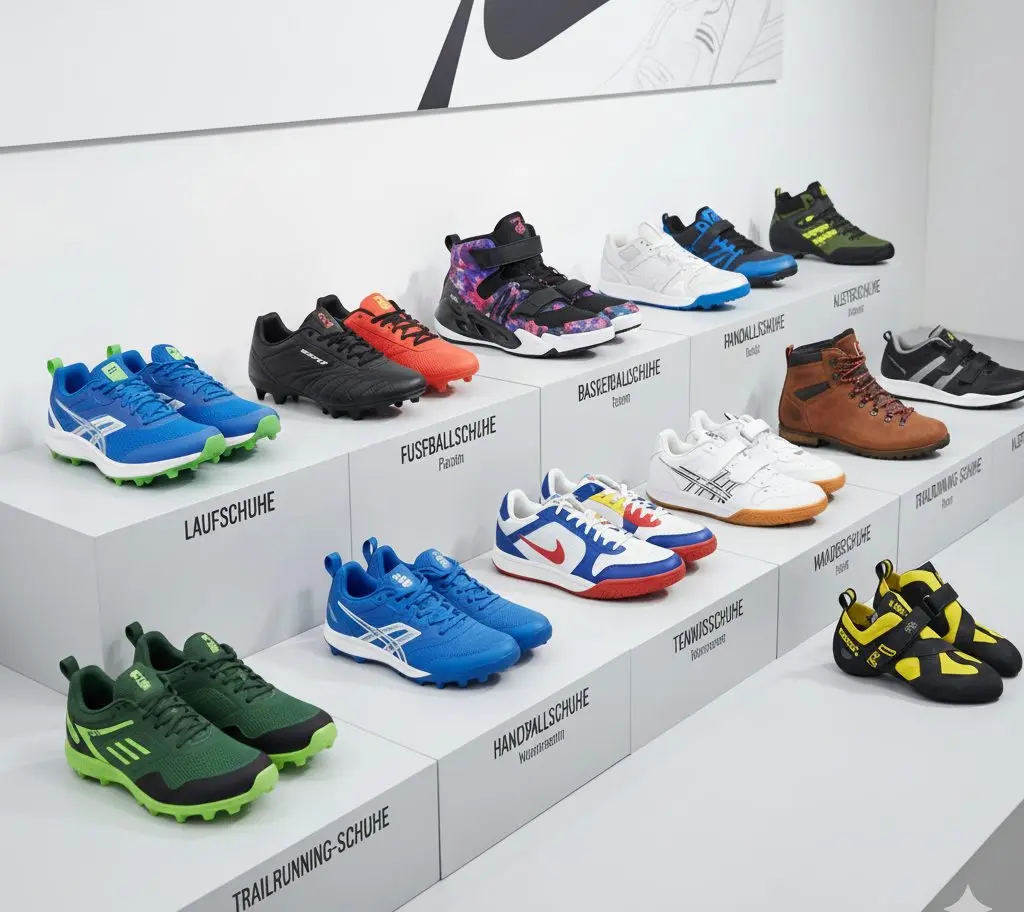
  • Running shoes (road, trail, competition)
  • Football boots (natural grass, artificial turf, indoor)
  • Basketball shoes
  • Handball shoes
  • Volleyball shoes
  • Tennis shoes
  • Fitness and training shoes
  • Hiking shoes
  • Climbing shoes
Prüflabor für Sportschuhe

Contact us

In 5 steps to a test report for sports shoes

Why should you have your sports shoes tested by Innoproof?

State-of-the-art testing technology

Our testing laboratory is equipped with state-of-the-art machines, such as the Instron Electropuls E3000. This technology enables precise, reproducible, and dynamic testing at the highest level. This ensures that your products are tested under realistic and precisely controlled conditions.

Owner-managed company with direct communication

As an owner-managed medium-sized company, we offer short decision-making paths and direct communication. Our customers benefit from quick availability and dedicated contacts throughout the entire project. This ensures efficiency, trust, and a collaborative partnership.

Meaningful test reports with added value

Our test reports are not only technically accurate but also clearly structured and easy to understand. High-quality images, clear graphics, and detailed explanations make results transparent and easy to compare. This provides you with a solid basis for decisions in development, quality assurance, and communication.

Sustainable testing without hydraulic oil systems

We deliberately avoid environmentally harmful hydraulic oil systems and rely exclusively on electrodynamic testing systems. This approach is more energy-efficient, cleaner, and requires less maintenance. In this way, we combine state-of-the-art testing technology with responsible use of resources.