



Methods for the mechanical testing of implant coatings
 The static testing of coating shear strength is described in ASTM F1044. The joining of the specimens and their alignment in the testing machine correspond to those used in dynamic tests.
The opposing, bonded layers are vertically aligned with their contact surface in the loading axis of the testing machine in order to ensure pure shear loading without bending. The specimen holders are mounted on double Cardan joints to decouple constraint forces.
The static testing of coating shear strength is described in ASTM F1044. The joining of the specimens and their alignment in the testing machine correspond to those used in dynamic tests.
The opposing, bonded layers are vertically aligned with their contact surface in the loading axis of the testing machine in order to ensure pure shear loading without bending. The specimen holders are mounted on double Cardan joints to decouple constraint forces. ASTM F1147 specifies a static test setup for determining the tensile or adhesive strength of coatings. The coating is applied to the end face of a cylinder, which is bonded to a second cylinder according to a defined protocol prior to testing.
The opposing bonded layers are axially aligned with their contact surface in the loading axis of the testing machine in order to ensure pure tensile loading. The specimens are mounted on double Cardan joints to decouple constraint forces.
ASTM F1147 specifies a static test setup for determining the tensile or adhesive strength of coatings. The coating is applied to the end face of a cylinder, which is bonded to a second cylinder according to a defined protocol prior to testing.
The opposing bonded layers are axially aligned with their contact surface in the loading axis of the testing machine in order to ensure pure tensile loading. The specimens are mounted on double Cardan joints to decouple constraint forces.- For testing the shear strength of coatings, ISO 13179-1:2014 specifies dynamic tests that reference the corresponding method in ASTM F1160-14. The coating is applied to the end faces of two cylinders, which are bonded together prior to testing.
The opposing bonded layers are vertically aligned with their contact surface in the loading axis of the testing machine to ensure pure shear loading without bending. The specimen holders are mounted on double Cardan joints to decouple constraint forces.
The ISO standard requires 10 million load cycles for a successful test.
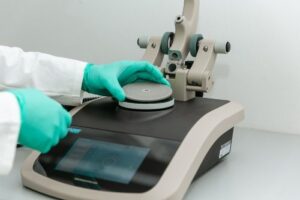 We offer measurement of the abrasion resistance of metallic thermal spray coatings using a Taber Abraser in accordance with ASTM F1978-18. The coating under investigation is subjected to controlled pressure and abrasion conditions on rotating discs. The specimen, mounted on a rotating platform, turns about a vertical axis against the sliding rotation of two abrasive wheels. One wheel abrades the specimen outward toward the periphery, while the other abrades inward toward the center.
The resulting abrasion marks form a pattern of crossed arcs over an area of approximately 30 cm². After a defined number (2, 5, 10, or 100) of cumulative rotation cycles, the specimens are cleaned in an ultrasonic bath. After each cleaning step, the specimens are dried and weighed. The mass loss serves as a measure of the abrasive wear of the specimen. INNOPROOF is accredited to perform this test.