
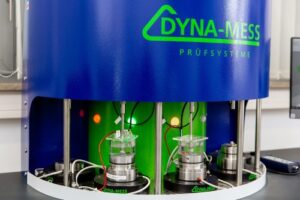
 DIN EN ISO 14801 describes a test method for fatigue (failure) of single-piece endosseous dental implants of various sizes and designs. The test should, as far as possible, simulate the clinical use of the implant, meaning that specimens representative of the finished product are tested and sterilized as required according to the manufacturer’s instructions. For testing, the specimen is rigidly clamped in the testing machine depending on the design (angled or non-angled abutments) and subjected to a uniaxial load for a defined number of cycles. To create a worst-case scenario, the implant is tilted by 30° during testing.
Additionally, the critical failure point and location are determined, which characterize permanent deformation, loosening of the implant assembly, or fracture of a component. If the implants contain corrosion-prone components or polymers, testing must be conducted in physiological saline solution at 37°C. For all other implant compositions, testing is performed in air at room temperature. All results are documented in a test report according to the standard.