
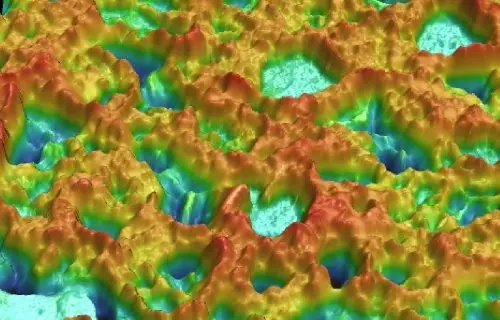
ISO 14607:2024 Annex G – Surface characteristics*

The testing of surface characteristics of breast implants according to ISO 14607:2024 is used to determine the surface roughness (Sa) as well as the surface complexity (Scx). Together with the type of surface texturing, this allows classification of the implant surface.
For roughness measurements, we use a confocal laser scanning microscope. The surface topography is scanned at magnifications of 10x or 20x. In addition to the arithmetic surface roughness (Sa), we also determine further parameters upon customer request, such as root mean square height (Sq), skewness (Ssk), kurtosis (Sku), maximum peak height (Sp), maximum pit height (Sv), maximum height (Sz), or density of peaks (Spd). The surface complexity (Scx) is determined using our digital microscope VHX-7000.
We use the proven punching technique according to ISO 37 to create as flat a cross-section as possible on the implant shell for the measurements. During evaluation, the complexity of the surface texture is determined in two-dimensional space.
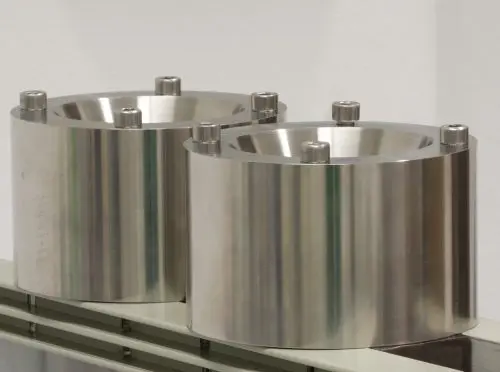
 We offer cohesion testing of silicone gel according to ISO 14607:2024 Annex E. In this test, only the filling is examined, not the shell. The silicone filling material is poured into a funnel with standardized dimensions and surface roughness. The gel is allowed to flow freely through the funnel’s lower opening for a duration of (30.0 ± 0.1) minutes.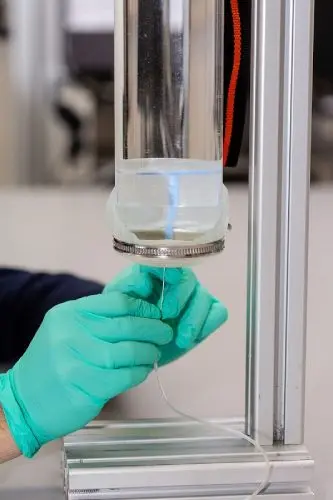
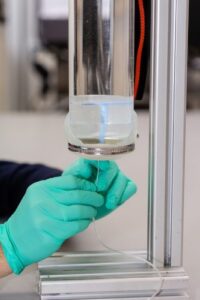 Annex D of ISO 14607:2024 describes the testing of the injection site of fillable tissue expanders (breast implants). The injection site is repeatedly pierced at the same spot with a needle while a water column exerts pressure on the passage.