
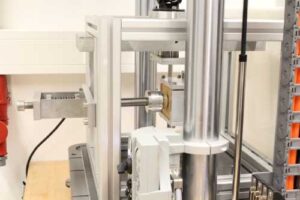
 We offer a testing procedure to evaluate the fixation strength of the glenoid component in bone and its resistance to subluxation caused by cyclic movement (e.g., superior-inferior or anterior-posterior) of the humeral head against the edge of the glenoid, according to the ASTM F2028 standard. This test method can be applied to both cemented monolithic and modular glenoid components as well as uncemented reverse glenoid components.
The glenoid component is fixed in a bone substitute material using bone cement, and the humeral head component is placed into the glenoid component. An axial load is applied through the glenoid component while the humeral head is moved in opposite directions to determine the maximum displacement before dislocation. Then, the humeral head is cyclically moved at a speed of up to 50 mm/min for 100,000 cycles in both directions until 90% of the displacement at dislocation is reached. During the test, axial displacement (rocking) of the glenoid edges is recorded. The test can be conducted dry or in water at 37°C.