
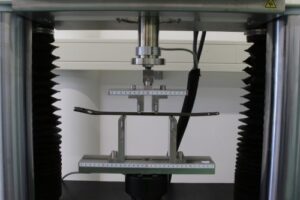
 We offer characterization of the design and mechanical performance of intramedullary nails in accordance with ASTM F1264.
- Static four-point bending test
An intramedullary nail is clamped in the test fixture and loaded until a significant drop in force occurs (fracture or material yielding). During the test, a force–displacement curve is recorded and evaluated with respect to bending stiffness and bending strength. - Dynamic four-point bending test
An intramedullary nail is clamped in the test fixture and loaded over a defined number of cycles. The applied load should correspond to 75, 50, or 25% of the bending strength and be applied at a frequency of 1–10 Hz. Subsequently, an M–N diagram (maximum bending moment versus number of cycles) is generated and the fatigue strength is determined. - Static torsion test
An intramedullary nail is clamped in the testing machine and a constant axial force (5–10 N) is applied. Subsequently, torsion of 5° is applied at a constant rate of 5°/min. A torque–rotation angle curve is recorded, whose linear slope corresponds to torsional stiffness. - Dynamic four- or three-point bending test of locking screws
The dynamic bending test of the locking screw is performed in accordance with the test procedure used for intramedullary nails.
In addition to the mechanical characterization of intramedullary nails, we are also pleased to advise you on correct labeling, packaging, and the content of the manufacturer information to be provided with the product.